Blog

Vision to Victory: Inside the Growth Accelerator Program Strategy Day
The Fresh Clinics Growth Accelerator Program is a first in the industry, delivered by renowned entrepreneurs from inside and outside aesthetics. Participants gain skills and insights to push the boundaries of their business and develop as leaders.
Think strategic road mapping, commercial analysis, advanced consultation training, building high-performing teams, and setting up scalable management systems - just to name a few.
The first cohort of Fresh Members in our Growth Accelerator Program recently gathered for the final event of the course. This full-day, in-person strategy deep dive took place at The Grounds of Alexandria in Sydney. The day marked the end of eight weeks of intensive learning, aimed at providing participants with the tools they need for clinic growth and long-term success.

The day began with a warm welcome from Suzie Hoitink from HTNK Advisory, and Rob Price, Fresh Clinics CCO, followed by a session designed to remind the group of their unique 'Why' - the passion that brought them into the aesthetics industry and what drives them every day.
Participants were split into small groups, and the morning was packed with actionable insights, starting with the completion of the Growth Accelerator Strategy Canvas.
Using LEGO® blocks, the cohort created physical representations of their motivations and values, sparking a creative reflection on their purpose as business owners. This exercise was not only fun but insightful, helping each person to define their vision, mission, and values.
Nurses then worked through strategic business questions, prompting answers on their Canvases. From this, they developed their elevator pitch, capturing what their clinic does, who it serves, and how it delivers value - all while aligning their team’s core values with daily operations.
During the second breakout session - "Building Your ‘'What'”, members concentrated on setting tangible business goals. This covered financial objectives, clinic productivity metrics, and long-term visions for their clinics.
Participants were encouraged to think about what they wanted to achieve in the next 12 months and the personal and professional milestones they aimed to achieve in the years ahead. Breaking down complex strategies into clear, actionable goals provided everyone with a solid foundation to build on.
After a delicious lunch, the afternoon was all about the ‘How’, and identifying the initiatives needed to put in place to reach their goals. Using metrics such as Average Appointment Value and Client Rebooking Rates, they learned how to evaluate the impact and effort required for each initiative. This practical approach enabled our nurses to prioritise high-impact actions that would deliver the best results with efficient use of time and resources.
Another highlight of the day was the fireside chat with The Skincare Company.
The discussion emphasised the importance of training staff to recommend cosmeceuticals confidently, educating patients on the benefits of skincare alongside injectables, and promoting these products through seasonal offers.
Participants were also given exclusive offers and discounts on The Skincare Company’s clinical range.

Roadmap For Success
The day concluded with a focus on the ‘When’ - prioritising initiatives over the next 12 months using an Impact/Effort scale.
Our nurses walked away with a clear, actionable roadmap for the year ahead, tested and refined through the support of peers and business coaches, setting them up for sustainable, long-term success.
By the end of the day, the cohort had fine-tuned their strategies and established the steps they’ll take to continue growing their business.
What’s Next?
The Fresh Clinics Growth Accelerator Program provided attendees with a wealth of knowledge through comprehensive modules, including branding, strategic planning, high-impact marketing, and skincare integration.
We are so proud of our first cohort and can't wait to witness the impact they will make in the coming months.
If you’re ready to take the next step in growing your clinic, now is the perfect time to join the waitlist for the next cohort of the Fresh Clinics Growth Accelerator Program. Your business transformation starts here.

Setting Up Your Own Clinic? Read This First
Staying up to date with TGA & AHPRA compliance regulations can often feel overwhelming. Whether you're a Registered Nurse or a Clinic Owner, navigating the licenses, permits, and insurance requirements is crucial for ensuring the safety and legality of your business.
Fresh Members recently heard from Jo, our Head of Compliance, for tips on making compliance a walk in the park, and not a daunting task.
Why Compliance Matters
Compliance in the aesthetic industry is a non-negotiable, not only for legal reasons but also for maintaining high standards of patient care and safety. Regulatory bodies have established guidelines for a reason; to ensure that both patients and practitioners are protected. Being compliant means adhering to rules set out for licenses, permits, training, and insurance.
Registration and Experience
Cosmetic Nurses need at least 12 months of post-graduate experience in a medical setting. This experience can be gained in hospitals, aged-care facilities, dermatology clinics, or similar specialties like plastic surgery. Jo explained, “To be a cosmetic nurse, you need a lot more experience than just injecting.”
Training
If a nurse has less than two years of injecting experience, additional assessments or training is important. Proof of such training is essential, and it’s something Clinic Owners should look for when hiring.
Professional Indemnity Insurance
Nurses must have Professional Indemnity Insurance, which covers various risks associated with cosmetic injectables. The amount of coverage required can differ, often ranging between five to ten million dollars. It's advisable to discuss this with an insurance provider to determine the best coverage for your specific practice. Don’t have an insurance provider to go to? Fresh Clinics can refer you to one through our Expert Hub resources.
Licenses and Permits
The requirements for licenses and permits can vary greatly depending on your state or local council. For instance, Queensland clinics need a Personal Appearance Services License for cosmetic injecting. Jo advises, “Always check with your local council to understand what is required for your clinic to avoid potential fines.”
Physical Setup
A compliant clinic also needs to meet several physical standards including:
- Signage and flooring: Proper signage and hard floors (no carpets)
- Hand washing facilities: These might require non-touch taps depending on the state
- Adjustable treatment beds
- Sharps bin
- Lockable storage and fridge for S4 medications*
*Having a lockable fridge with a temperature gauge is mandatory for storing S4 medications at the required temperature (between 2 and 8 degrees C). Every clinic needs to record the temperature of its fridge which can be monitored using devices like Clever Logger.
Emergency Medication Management
Nurses must maintain a meticulous record of drugs and emergency medications like hyaluronidase (HILA) and adrenaline. Always ensure these medications are in date and documented appropriately.
Effective from September 1st 2024, new protocols require two boxes of Hyalase for emergencies. This change stems from recent vascular occlusions that required more than the previously mandated five ampules. Jo stressed the importance: “I can assure you, you would be happy if you’ve got two boxes if a VO ever happens.”
Practical Tips
- Stay Updated on TGA & AHPRA Regulations: Regulations can change. Regularly check with local councils and regulatory bodies to stay informed about new or updated compliance requirements
- Reliable Insurance Providers: Providers like WestRock and CNI specialise in cosmetic injectables and can help ensure you get the coverage you need
Navigating compliance in cosmetic clinics may seem like a complex challenge, but understanding the core requirements, and utilising the right resources, can make it much more manageable. Prioritise patient safety by adhering to regulations and keep your business running smoothly by staying informed and prepared.

Navigating Uncertainty: How Fresh Clinics is Helping Tasmanian Nurses Overcome a Historic Legislative Hurdle
Picture this: You head to work excited for a busy day of back-to-back patients. The clinic is alive with activity, and you’ve just performed one of your favourite procedures.
Then it happens - a single phone call that shatters the normalcy. An abrupt legislative change crashes down, signalling an immediate halt to your clinic. Your scripting company abandons you, refusing to return your calls and emails for support, leaving you grappling with the uncertainty that lies ahead. Sounds like your worst nightmare, doesn't it?
This was the reality faced by nurses operating in Tasmania, only two weeks before Christmas.
Newly introduced changes brought private practicing cosmetic nurses under strict scrutiny from the Department of Health (TAS), enforcing a thorough examination of professional practice, especially concerning cosmetic injectables.
This legislation meant that for cosmetic nurses in Tasmania to continue their private practice, they had to be authorised by the pharmaceutical Minister of Health with a section 25A of the Poisons Act - proof of capability to receive, store, and use S4 medications. This ultimately required clinics to be licensed and operate as day-procedure clinics - meaning buildings had to be re-fitted, policies revised, and new documentation assembled to meet the strict new compliance criteria.
Despite these changes, Fresh Clinics rose to the challenge and helped create a legislative framework, which, after some back-and-forth discussions, was finally approved by the Department of Health in April 2023.
However, by the end of 2023, most insurance companies decided not to insure any cosmetic nurses without a section 25. We were forced to halt the supply of S4 medications to our clinics in Tasmania, and our Nurses had to stop treating patients immediately. A massive blow for our nurses, caught off-guard and left hanging with their livelihoods at stake.
The impact: Nicola's story
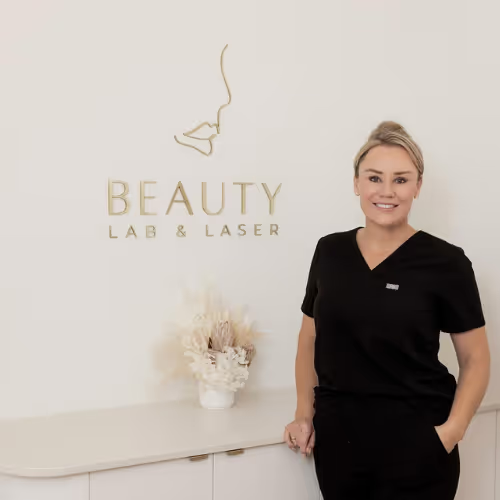
We spoke with our Head of Compliance, Jo, and Nicola, a Fresh Clinics member and Tasmanian nurse impacted by these changes, to bring you some truthful insights into the challenges fellow Tasmanian nurses encountered, and are still facing today.
Nicola Paine, owner of Laser Lab and Beauty in Hobart, shared her journey navigating these changes. "When we first heard about the legislation, everything seemed blurred and grey. We weren't really given a lot of straight answers," Nicola started, reflecting on the ordeal. "One day, another nurse and I received a letter from AHPRA, questioning our practices according to the local legislation."
Despite unwavering support from Fresh Clinics, her journey was not short of a struggle. Nicola recalled the devastating moment of receiving the call from Jo. “I could just tell by the tone of her voice that it wasn't going to be good news. She told me that I had basically until tomorrow to find somewhere to be compliant, or I'd have to stop practicing. I was absolutely devastated."
Even in the ordeal she faced, Nicola couldn’t hide her gratitude. "If it wasn't for Fresh Clinics, we would all probably be in a very different place right now… they were always there during the most difficult times, supporting, advising, and even lending a shoulder to cry on.”
Throughout this journey, our Tasmanian community demonstrated an inspiring example of determination in the face of uncertainty. Nicola’s story offers hope to other nurses across the country, especially those who might be worried about future legislative changes. It’s a timely reminder for nurses to actively seek and understand the distinct requirements of their local Department of Health and maintain a proactive approach toward compliance.
Nicola was the first of many Tasmanian nurses Fresh Clinics has supported to become compliant in the last month. Now that the process and infrastructure has proven successful, the focus now turns on revitalising the business of other Tasmanian clinics. Fresh Clinics remains, to this day, the sole provider in Tasmania with the processes, systems, and team in place to support cosmetic nurses in ensuring and maintaining their compliance.
Not a Fresh Clinics member yet? Reach out to our team today, call us, or schedule a time to chat below to discuss how to become a Fresh Clinics member and take advantage of Fresh initiatives today.

Compliance: Fresh Clinics Supports You Every Step of the Way
Recent regulatory updates in Queensland have significantly changed the classification and management of cosmetic injectables.
These treatments are now categorised as higher-risk personal appearance services and regulated under the Public Health (Infection Control for Personal Appearance Services) Act 2003. The changes require practitioners to obtain a local council license and complete the HLTINF005 Maintain Infection Prevention course.
This regulatory change brings a clear message: compliance isn't optional. The consequences of non-compliance are serious, with fines that could disrupt professional practice.
However, staying compliant is about more than avoiding penalties. It’s about protecting patients, maintaining integrity, and demonstrating a commitment to high safety standards.
Given only a three-month grace period to meet these requirements, Fresh Clinics moved quickly to lead the way in compliance support.
Recognising the urgency and importance of these changes, Fresh became the first in the industry to launch a fully accredited infection control course tailored specifically for aesthetic professionals, by partnering with the Australasian Academy of Cosmetic Dermal Science (AACDS).
Unlike other training options, Fresh Clinics’ infection control course was developed to address the unique needs of aesthetic professionals. Its streamlined structure and focus on cosmetic procedures provide an efficient, industry-specific pathway to compliance:
- 100% Online Delivery: We are the first in the industry to offer this course online. This eliminates the need for in-person attendance and ensures minimal disruption to work hours for our Members
- No Autoclave Requirement: Unlike other courses, this training removed the need for an autoclave, simplifying the process
- Fast Completion Time: The course requires only 8-12 hours of study, making it the most time-efficient option available
- Comprehensive Solution: Fully aligned with national standards and the requirements of the QLD Public Health Act 2003, this course ensures practitioners can operate with confidence
The introduction of these regulatory changes presented challenges for our Members in QLD. However, by offering practical, tailored solutions, Fresh Clinics reinforced its position as the go-to partner for compliance in aesthetics in Queensland and beyond.
Fresh Clinics remains committed to supporting the growth and success of aesthetic professionals across Australia. By staying ahead of industry changes and continuously innovating, the team ensures its Members are equipped to thrive in an evolving regulatory landscape.
With Fresh Clinics in your corner, you can continue to grow your business while confidently meeting the latest requirements.

Transformative Growth Accelerator Program Launched at Fresh Clinics
At Fresh Clinics, we are always on the lookout for business opportunities for our Members.
We recently launched our Growth Accelerator Program, which helps cosmetic clinics book more appointments and grow sustainably, marking a big leap forward for the aesthetics industry.
This three-month intensive course is tailored to help cosmetic nurses excel in their commercial, leadership, and marketing skills, paving the way for transformative growth.
Our Growth Accelerator Program is a first in the industry, combining webinars, workshops, clinical training, and an offsite strategy day. It’s all delivered by renowned entrepreneurs from both inside and outside aesthetics. Participants gain invaluable skills and insights to push the boundaries of their business and develop as leaders.
But here’s what sets our program apart:
We focus on those critical skills that most clinicians miss out on when they transition to running their own businesses.
Think strategic roadmapping, commercial analysis, advanced consultation training, building high-performing teams, and setting up scalable management systems - just to name a few. The program wraps up with a strategy offsite day; the perfect blend of education and enjoyment, allowing Members to connect and network with like-minded peers.
Rob Price, CCO of Fresh Clinics, shared the inspiration behind this initiative:

The first round of the Growth Accelerator resulted in a waitlist after just 2 months. This overwhelming response highlights just how much demand there is for a game-changing program like this in the cosmetic industry.
If you’re ready to take your clinic to the next level and be part of this exciting journey, don’t miss out on the opportunity to join the next round of the Growth Accelerator Program. Click here for more information and to secure your spot on the waitlist!
Featured in Spa & Clinic
The Growth Accelerator Program featured in Spa & Clinic! Read the full article here.

How to Attract and Keep the Right People in Your Clinic
Watch the full session here.
When we asked clinic owners about their biggest growth challenges in the 2025 State of Medical Aesthetics Report, nearly a quarter said one thing stood out: finding and keeping the right staff. And it’s not surprising. Having the right people beside you can make or break your business.
That’s what we recently explored in our SoMA session, 'Building Your Dream Team: Attracting and Keeping Top Talent in Your Clinic.' Hosted by Aniella, Business Development & Key Account Manager, from Fresh Clinics, the discussion featured two inspiring clinic owners, Olivia from A&O Cosmetics and Skin in Shepparton, and Hannah from Self Cosmetic Science in Adelaide. Between them, they’ve grown thriving teams in very different markets, but share one philosophy: get the culture right, and the rest will follow.
Hiring in a regional vs. city market
For Olivia, building a team in regional Victoria brings both challenges and benefits. “The pool that you are employing from is significantly smaller,” she shared. “People just really aren’t floating around here, being cosmetic nurses.” But being in a small town also means connections run deep. “When you do interview people, I’ve always known of them somehow. It has its pros and cons, but it’s worked out well for us so far.”
Hannah agreed that hiring is rarely easy, even in Adelaide. “It has taken time; we haven’t always had our dream team. I always say hire on personality, not on skill, and hire slowly. Our last hire took nine months. Do not rush it.”
Why personality matters
Both speakers agreed that a candidate’s personality, values, and ethics matter far more than their resume. As Hannah explained, “I don’t really care what experience someone has… they just need to be a good person and have really good ethics. I’m more than happy to then train someone up; they just need to be the right fit for the team.”
Olivia added that passion is a major green flag in an interview. “Those that’ll just be like, ‘I’ll do anything to work for you’ - that’s the drive you want to see.”
On the flip side, there are red flags that are just as obvious. Hannah warned against candidates who speak negatively about previous employers: “It puts a question in my mind - am I then going to be the person they talk about at their next interview?”
Rethinking the interview process
Like most business owners, both Olivia and Hannah admitted their approach to interviewing has evolved over time. Olivia laughed, remembering how nervous she was in her first interview: “I felt like I was going to vomit before it. It just came very unnaturally.” Today, her interviews are more conversational, focusing on personality and goals rather than stock standard questions. “I just trust my gut a lot more now,” she said.
Hannah has also moved away from rigid Q&As. “We try and be a lot more conversational now. We peel the onion back, find out their motivations, and we’re much more direct. Before, we wanted our staff to like us, but now it’s about making sure it’s the right fit both ways.”
Retention through culture
Attracting staff is one thing, but keeping them is where the real work begins. For both Hannah and Olivia, the secret lies in culture.
Flexibility is non-negotiable. “Most of my staff are mums. I’m a mum to two kids, so I get the juggle,” said Olivia. “If they need time off or want to go on holiday, if you give me notice, it’s nearly always a yes.”
Hannah has taken the same approach: “We only work a four-day work week. We don’t work weekends, and we’re not open on Wednesdays. Our staff absolutely love it.”
Recognition also plays a huge role. Olivia is deliberate about making her staff feel valued: “I’m always thanking my staff and celebrating their achievements. Feeling valued and appreciated is something you don’t get in a lot of workplaces, but it’s so important.”
Beyond pay and perks, what keeps staff loyal is the sense of belonging. Hannah’s approach is to find out what motivates each individual. “For some, it’s discounted treatments. For others, it’s flexible working arrangements or more education opportunities. It’s not always the obvious things.”
Both Hannah and Olivia also invest in shared experiences. From team dinners and after-work drinks to attending conferences together, they emphasise the importance of connection. “We’ve all become quite good friends,” said Hannah. “We celebrate our wins together, and that makes a huge difference.”
Setting new hires up for success
The onboarding process can make or break a new hire’s success. For Olivia, that means shadowing from day one, no matter how much prior experience someone has. "Regardless if they have experience, we will be doing things differently. It’s also about introducing them to the team, my family, even my kids - it’s social as well as clinical.”
Hannah also emphasised shadowing, but with a focus on consulting skills and clinic culture. “It’s not just about teaching them clinical skills. It’s more about how to talk to clients, our policies, and our procedures. That really can’t be taught in a day.”
Building your dream team isn’t about luck. It’s about patience, leadership, and creating a culture where people feel valued. As Olivia summed it up, “This is an us thing, it’s never a me thing. As I grow, I want to bring my team up with me.” When you put people first, you don’t just attract talent, you keep it.
Want more industry insights and business tips you won't find anywhere else? Join Fresh now!
Building your dream team: Attracting and keeping top talent in your clinic
Access this exclusive session with some of Australia's top clinics as they share their insights on how to build a thriving team.
Brought to you by Fresh Clinics exclusive State of Medical Aesthetics Report, 2025
Join our special guests:
- Olivia Feldtmann, ANO Cosmetics and Skin
- Hannah Rivers, Self Cosmetic Science
- Hosted by Aniella Leeks, Business Development and Key Account Manager at Fresh Clinics
What you'll learn:
- Simple but effective recruitment approaches that help you find the right fit, not just the right resume
- Onboarding secrets that set new team members up for success from day one
- How to create a clinic culture that makes staff want to stay for the long-term
- Practical leadership techniques that boost team satisfaction and performance

Breaking the Stigma: Complication Management in Aesthetics
In aesthetic medicine, although rare, complications can and do happen. But rather than seeing them as failures, it’s time to shift the narrative.
Although these complications occur infrequently, their potential impact necessitates transparency, preparedness, and ongoing education.
During our recent international webinar, bringing together Members from the USA and Australia, Fresh Clinics co-founder Dr John Holbrook led a candid discussion on complication management, breaking down stigma, and ensuring patient safety remains the top priority in aesthetics.
A New Perspective on Complications
“Bad things happen. They’ll happen to all of us,” Dr Holbrook stated. “What matters more than anything is recognizing, escalating, and managing it appropriately.”
One of the most critical complications discussed was vascular occlusions (VO). Vascular occlusions are a rare but serious complication associated with dermal fillers. They occur in fewer than 0.05% of treatments.
Dr Holbrook reinforced that quick recognition and treatment are key: “Anytime you see vesicles, think necrosis. The answer is simple - open up the vessel with hyaluronidase.”
Vascular occlusion can sometimes be misdiagnosed due to varying symptoms, but practitioners were urged to act swiftly. “Pain is a helpful sign, but just because it’s painless doesn’t mean there’s no occlusion,” Dr Holbrook advised.
The Reality of Infections
While vascular occlusions require immediate dissolving of filler, infections can be more challenging. Immune-mediated inflammatory reactions can present anywhere from days to years after HA filler was initially injected. The swelling and tenderness in the distribution where the fillers were injected are often, but not always, triggered by illness in the patient a couple days prior to the swelling.
NSAIDs and prednisone are typically used to manage these reactions. If an infection is suspected, antibiotics and dissolving the filler are standard therapy. Dr Holbrook highlighted, “You are obliged to dissolve any filler post-infection, no matter what.”
Practitioners were reminded to take a proactive approach with close patient monitoring to prevent further complications such as abscess formation.
Seeking to maintain adverse events at less than 1% of treatments that occur is a shared mission. The Monthly Morbidity and Mortality (M&M) meetings hosted by Fresh Clinics highlight where and how practice can continuously improve.
No Practitioner is Alone
Breaking the stigma around complication management requires a collective shift in perspective.
Complications are not a reflection of incompetence but are part of cosmetic medicine and an opportunity to learn, improve practice, and enhance patient safety. Fresh Clinics offers ongoing support through its medical team, software, and training to ensure all practitioners have the knowledge and confidence to navigate complications.
If you want to be part of a network that prioritises safety, education, and professional growth, explore how Fresh Clinics can support you. Reach out to our team today.

Complications in Aesthetic Procedures: Insights from Dr. Shah-Desai
-2.avif)
The content of this blog is designed and intended for the education of Healthcare Professionals
In our rapidly evolving industry, the use of hyaluronic acid (HA) fillers for facial enhancement is always on the rise. However, with innovation comes challenges. Fresh Clinics Members recently heard invaluable insights from Dr. Sabrina Shah-Desai, an internationally recognized expert in non-surgical and advanced cosmetic procedures on the prevention and management of complications associated with (HA) filler use.
Understanding the Anatomy
To optimally leverage fillers in aesthetics, an understanding of facial planes and the distribution of facial vasculature is a must. Enlightening us on this, Dr. Shah-Desai reinforced, "Prevention strategies are really important to understanding that depth of injection, injecting slowly, considering a cannula except in the nose, injecting small, and considering directing the needle perpendicular to the vessels."
Patient Assessment
Sabrina made sure to emphasise the importance of patient assessment and consultation in the following order to minimise risks during treatment:
- Take a detailed medical history
- Take a detailed aesthetic history (types of filler used/dates of treatment)
- Assess for any ongoing skin conditions, dental issues, and ear, nose, or throat issues
- Establish if there is any severe pain or redness in past treatments
- Establish duration and onset of “the lump”
One of the main risks associated with HA filler injections is the threat of vascular events. How we handle such events can make a significant difference in the patient's outcome. Complications ranging from infections to nodules and even blindness can occur, hence having a well-trained team in place, armed with the necessary tools and medications, is crucial.

"Anatomy and assessment of patient selection is a prerequisite for minimising the risk of complications. Never inject against resistance and considering the product is really important, particularly to prevent complications," said Dr. Shah-Desai, reinforcing the importance of comprehensive knowledge in filler treatments.
Navigating Complications
The importance of early detection, diagnosis, and management of adverse events cannot be overemphasised. For infections, the use of antibiotics might be considered while Hyaluronidase could be employed for treating nodules. Here, using ultrasound devices on patients would offer compelling advantages.
Aging and Filler Placement
Our skin undergoes transformations with age, leading to structural support and surface alterations. . Sabrina shed light on this, highlighting "When we look at the surface topographical changes of aging we see this on the skin sort of from the ages of late 20s to mid 30s."
The awareness of these changes, especially in the mid-face and bony areas, forms the underpinning for informed decisions on filler placement and selection in patients.
The 4D Approach
Steering away from static notions, Sabrina introduced the concept of the 4D approach for optimising results with filler. This approach unravels a more holistic outlook in evaluating and enhancing facial features, acknowledging the dynamic fat pads and movements that define our faces.
The 4D approach is based on four key strategies and can have fewer complications, plus more revenue for your practice than filler alone:
- Protection (eg, sunscreen and antioxidants)
- Promotion of cell turnover (eg, peels and laser)\
- Collagen stimulation
- Volume remodelling (eg, fillers)
Empowering Your Practice
Sabrina's enlightening session contextualises the importance of preparedness at each step of aesthetic treatments.
The core takeaway from Dr. Shah-Desai resonates with Fresh Clinics’ belief that knowledge and awareness are the foundation of excellence in aesthetics. By embracing these insights, we can look forward to an exciting future in advanced technology.
Stay tuned for more inspiring discussions.
Not a Fresh Clinics member yet? Reach out to our team today, call us, or schedule a time to chat below to discuss how to become a Fresh Clinics member and take advantage of Fresh initiatives today.